EST vs EDT: What's the Difference and When Does Each Apply?
EST is UTC-5 and EDT is UTC-4. The switch happens twice a year with daylight saving time. Here's what each abbreviation means and why the distinction matters.
- EST
- EDT
- time zones
- DST
- Eastern Time
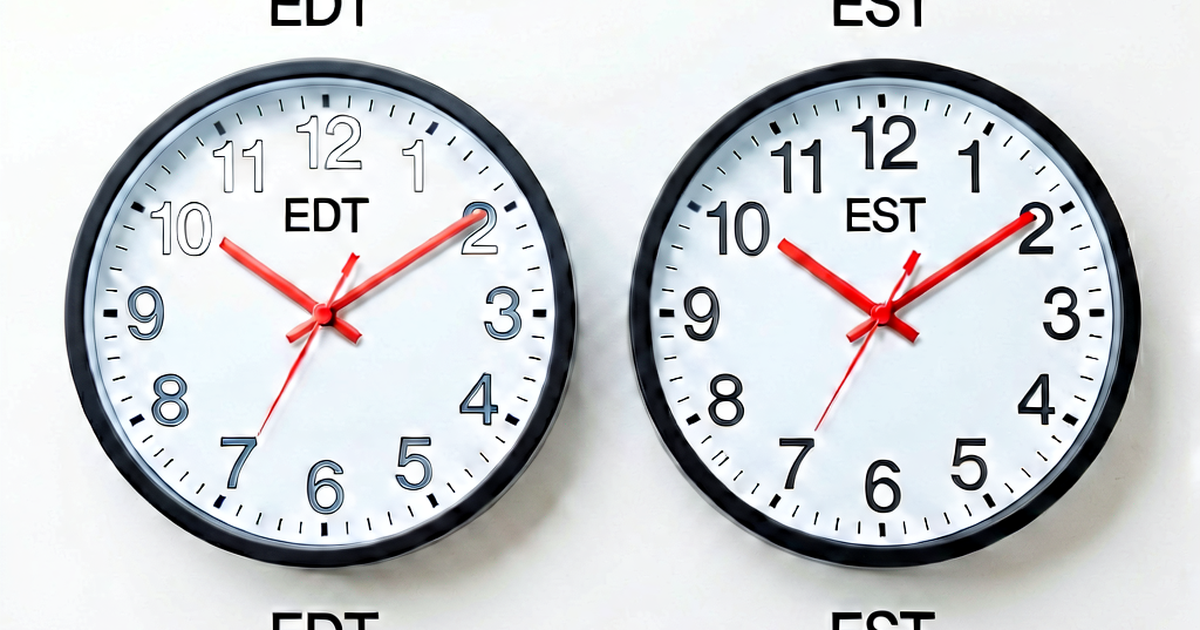

If you’ve ever noticed that a TV network advertises a show at “8 PM EST” in July — when the US East Coast is actually observing Eastern Daylight Time — you’ve run into one of the most persistent inaccuracies in casual timekeeping. EST and EDT are not the same thing, but they’re used interchangeably so often that most people don’t realize there’s a difference.
Here’s what each abbreviation actually means and when each one applies.
EST: Eastern Standard Time
EST stands for Eastern Standard Time. It is a fixed offset of UTC-5, meaning the Eastern US is five hours behind Coordinated Universal Time when standard time is in effect.
EST applies from the first Sunday in November, when clocks “fall back,” to the second Sunday in March, when clocks “spring forward.” During this period — roughly November through mid-March — New York, Miami, Atlanta, Boston, Washington D.C., and other Eastern cities are all on EST.
So if it’s 12:00 UTC noon in the winter, it’s 7:00 AM in New York.
EDT: Eastern Daylight Time
EDT stands for Eastern Daylight Time. It is a fixed offset of UTC-4, meaning the Eastern US is four hours behind UTC when daylight saving is in effect.
EDT applies from the second Sunday in March through the first Sunday in November. This covers most of the calendar year — roughly eight months out of twelve. During this window, Eastern cities are one hour ahead of where they were during standard time.
So if it’s 12:00 UTC noon in the summer, it’s 8:00 AM in New York — one hour later than in winter.
When the Switch Happens
The US transitions between standard and daylight time on specific Sundays:
- Spring forward: Second Sunday of March, at 2:00 AM local time. Clocks jump from 2:00 AM directly to 3:00 AM, losing an hour.
- Fall back: First Sunday of November, at 2:00 AM local time. Clocks fall from 2:00 AM back to 1:00 AM, gaining an hour.
The exact dates shift slightly each year because they’re defined by day-of-week rather than a fixed calendar date. In 2026, for example, the spring transition falls on March 8 and the fall transition falls on November 1.
Why “EST” Is Wrong Most of the Year
Here’s the irony: because EDT covers about eight months of the year and EST covers only about four, most time-sensitive Eastern US references — deadlines, event listings, broadcast schedules — actually fall during the EDT period. But broadcasters, PR teams, and websites often write “EST” regardless.
This is wrong in a technical sense, and it can actually cause scheduling errors if you’re in a different country and doing careful offset math. If someone tells you a webinar is at “2 PM EST” in June and you assume UTC-5, you’ll show up an hour late. The correct offset in June is UTC-4 (EDT), so “2 PM ET” in June = 18:00 UTC, not 19:00 UTC.
”ET” as the Safe Abbreviation
To avoid this confusion, the technically correct approach is to use “ET” — Eastern Time — as a season-agnostic abbreviation when you don’t want to specify whether it’s EST or EDT. ET automatically implies whichever offset is currently in effect for the Eastern time zone.
Many broadcast networks, event organizers, and US government agencies have adopted this convention. If you’re writing a newsletter or scheduling a recurring event, “ET” is cleaner and more accurate than guessing which of EST or EDT applies.
Why This Matters in Practice
For casual conversation, EST vs EDT rarely causes confusion because most Americans implicitly understand that Eastern time shifts seasonally, even if they don’t use the abbreviations precisely.
The stakes get higher in a few situations:
International scheduling: If you’re converting Eastern time to a timezone in a country that doesn’t observe daylight saving — or observes it on different dates — using the wrong offset can put you off by an hour. India Standard Time (IST) is always UTC+5:30. If you’re scheduling a call between New York and Mumbai and you use EST (UTC-5) when it’s actually EDT (UTC-4), your offset calculation will be wrong.
Software and APIs: Time zone abbreviations like “EST” and “EDT” are ambiguous in programming contexts. The IANA time zone database — the standard used by most operating systems and programming languages — doesn’t use these abbreviations. It uses identifiers like America/New_York instead, which automatically account for DST transitions based on the date. If you’re writing code or building a scheduling tool, rely on IANA identifiers rather than abbreviations.
Legal and contractual deadlines: A filing deadline stated as “5 PM EST” in August is technically wrong, and a strict reading could create disputes. Legal documents tend to specify the IANA zone name or refer to “prevailing Eastern time” to avoid the ambiguity.
Quick Reference
| Abbreviation | Full Name | UTC Offset | When It Applies |
|---|---|---|---|
| EST | Eastern Standard Time | UTC-5 | ~Nov – mid-Mar |
| EDT | Eastern Daylight Time | UTC-4 | ~mid-Mar – Nov |
| ET | Eastern Time | UTC-5 or UTC-4 | Year-round (safe abbreviation) |
When in doubt about which offset applies on a specific date, a world clock tool will show you the current Eastern time alongside UTC, making the math immediate and unambiguous.

Related reading
-
How to Schedule Meetings Across Time Zones Without the Confusion
Time zone math is error-prone. Here's a practical system for scheduling meetings with remote and international teams — including DST traps and overlap strategies.
-
Daylight Saving Time Explained: Why It Exists and How It Works
Daylight saving time shifts clocks forward in spring and back in fall. Here's the real history, which countries use it, and why software engineers dread it.
-
US Time Zones Explained: All 6 and What States They Cover
The US has 6 standard time zones — ET, CT, MT, PT, AKT, and HT. Here's which states fall where, their UTC offsets, and the notable exceptions worth knowing.